
The 58% Rule: Why Your Overhead Lights Are Destroying Your Sleep Hormones
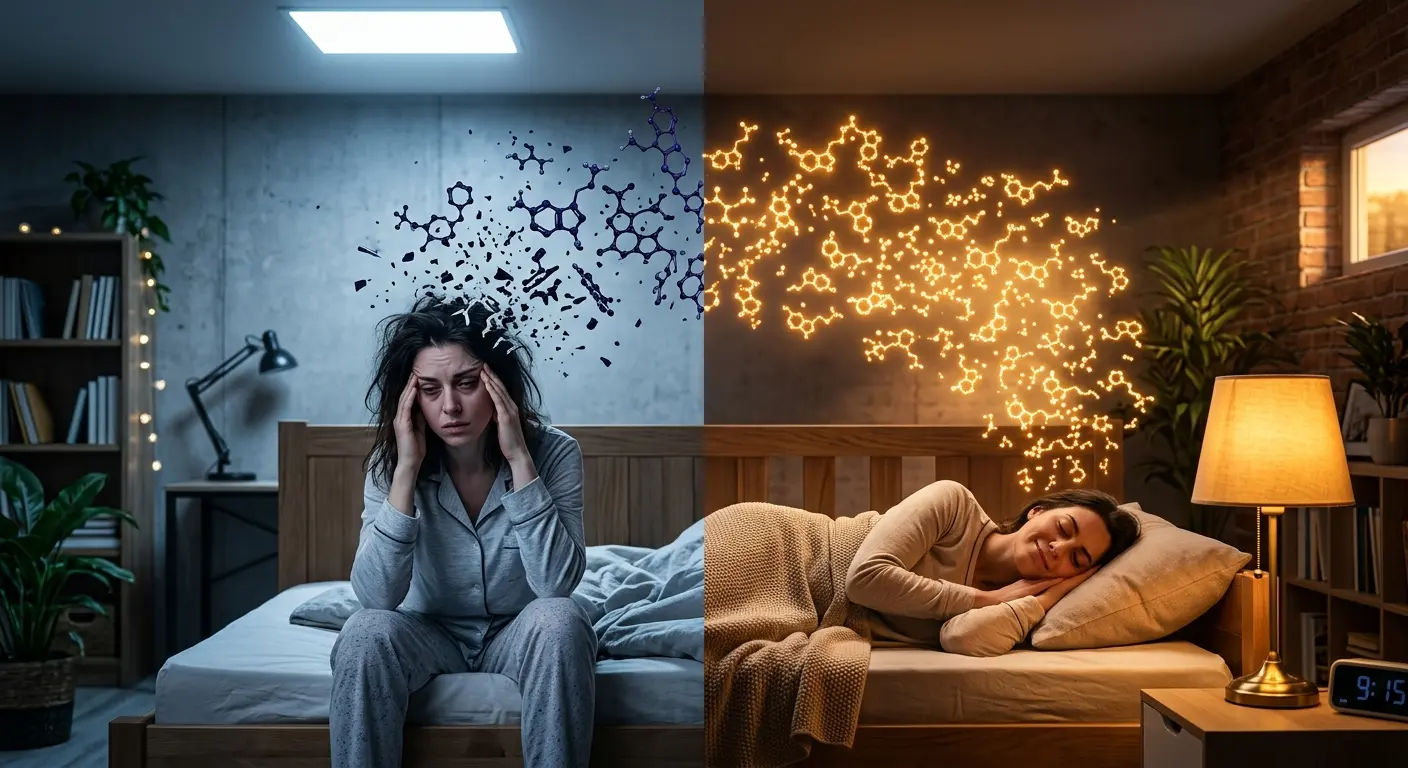
You're not broken. You're just running on 42% of your recovery hormones.
That's the startling reality behind what sleep experts are calling the 58% Rule — and it's silently sabotaging your sleep, your performance, and your long-term health.
The 58% Rule Explained
Here's the headline: Just one hour of standard overhead lighting before bed suppresses melatonin production by 58%.
Let that sink in. If you're like most people, you spend your evening hours under the glow of ceiling lights, kitchen fixtures, and living room lamps. During that time, your body's primary sleep hormone — melatonin — is being cut by more than half.
Melatonin is your brain's biological signal that it's time to rest. When production drops by 58%, you're essentially telling your body it's still daytime, even as you're preparing for bed. The result? You fall asleep later, sleep more lightly, and wake up feeling far less restored than you should.
The Science Behind the Suppression
The mechanism is straightforward but profound. Your eyes contain specialized photoreceptors that are exquisitely sensitive to light — particularly the blue wavelengths that are abundant in standard overhead lighting, LED bulbs, and fluorescent fixtures.
When these photoreceptors detect blue-enriched light in the evening, they send a signal to your brain's master clock (the suprachiasmatic nucleus) that it's still daytime. In response, your pineal gland dramatically scales back melatonin production.
This isn't a minor effect. Research published in Scientific Reports found that nearly half of homes have lighting bright enough to suppress melatonin by 50% or more — with individual responses ranging anywhere from 0% to 87% suppression for the average home. Some people are affected by light levels dimmer than a candle.
A Harvard Medical School study published in the Journal of Clinical Endocrinology & Metabolism found that exposure to room light before bedtime suppressed melatonin in 99% of participants and shortened melatonin duration by approximately 90 minutes. Another study found that a standard overhead light delayed melatonin release by nearly two hours.
Beyond Sleep: The Domino Effect
Melatonin suppression isn't just about feeling tired. The cascading effects ripple through your entire physiology:
1. Shallower Sleep Architecture
When melatonin is suppressed, you spend less time in deep, restorative sleep stages. Studies show that sleeping with lights on is associated with increased light sleep (Stage N1), decreased slow-wave sleep, and more frequent arousals throughout the night. This means you're not getting the cellular renewal and memory consolidation that happens during deep sleep.
2. Metabolic Disruption
Light exposure during sleep doesn't just affect your rest — it affects your metabolism. Research demonstrates that a single night of exposure to room light during sleep can impair next-morning glucose homeostasis and decrease insulin sensitivity. In other words, your evening lighting choices could be contributing to metabolic dysfunction and insulin resistance.
3. Elevated Heart Rate
Sleeping with even moderate light exposure keeps your heart rate elevated during the night compared to sleeping in complete darkness. This chronic sympathetic nervous system activation puts unnecessary strain on your cardiovascular system.
4. Circadian Phase Delay
Evening light exposure doesn't just suppress melatonin for that night — it shifts your entire circadian clock later. This means it's harder to fall asleep the next night, and the night after that, creating a vicious cycle of delayed sleep timing.
Why Overhead Lights Are the Worst Offenders
Not all light is created equal. Overhead lighting is particularly problematic for several reasons:
Blue Light Dominance: Most modern overhead fixtures — especially LEDs and compact fluorescents — are enriched in the blue portion of the light spectrum. This is the exact wavelength that most powerfully suppresses melatonin.
High Intensity: Ceiling lights typically produce higher lux levels than table lamps or floor lamps. A 2026 study found that cool white LEDs suppressed melatonin at more than three times the rate of warm white LEDs in the evening.
Wide Field of View: Overhead lights illuminate your entire visual field, maximizing the light signal reaching your photoreceptors.
Unconscious Exposure: We often don't think twice about flipping on the "big light" when we enter a room. It's an automatic habit that costs us dearly in sleep quality.
Individual Sensitivity: Why You Might Be Affected More
Here's where it gets personal: light sensitivity varies dramatically between individuals.
Research shows that some people experience virtually no melatonin suppression from typical home lighting, while others experience suppression of 80% or more. This variability explains why some people can watch TV right before bed and fall asleep instantly, while others are kept awake by a dim nightlight.
Factors that influence your sensitivity include:
- Recent light exposure: People who get less daytime sunlight exposure are more sensitive to evening light suppression
- Genetics: Variations in melanopsin genes affect how your eyes respond to light
- Age: Children experience roughly twice the melatonin suppression from light compared to adults
- Medication: Some antidepressants can dramatically increase light sensitivity
The Solution: Reclaim Your Sleep Hormones
The good news? The 58% Rule is completely avoidable. Here's how to protect your melatonin production and optimize your sleep:
1. Kill the "Big Light" After Sunset
The single most impactful change you can make is to stop using overhead lights in the evening. Switch to low-level, warm-toned lamps after dinner. Think of it as creating a "cave" environment that signals safety and rest to your brain.
2. Choose Warm, Low-Intensity Lighting
If you must use artificial light in the evening, opt for:
- Warm white LEDs (2700K or lower) rather than cool white
- Low-wattage bulbs (under 40W equivalent)
- Red or amber spectrum lights — these have the least impact on melatonin
- Candles or candle-like lighting — research shows candles suppress melatonin far less than standard bulbs
3. Create a 1-Hour "Screen and Light" Wind-Down
Start your wind-down routine at least one hour before bed:
- Dim all lights in your home
- Put away phones, tablets, and computers
- Use night mode or blue light filters on any necessary devices
- Read a physical book under warm, dim light
- Listen to podcasts or music in low light
4. Optimize Your Bedroom
Your sleep environment should be completely dark:
- Use blackout curtains or shades
- Cover or remove any light-emitting electronics
- Consider a sleep mask if you can't achieve total darkness
- Keep the room cool (around 65°F / 18°C)
5. Get Bright Light During the Day
Paradoxically, getting more bright light during the day makes you less sensitive to light at night. Make a point to get natural sunlight exposure in the morning — it strengthens your circadian rhythm and makes evening melatonin production more robust.
The Takeaway
The 58% Rule isn't just a catchy statistic — it's a wake-up call. Your evening lighting habits are actively working against your biology, suppressing the very hormones you need for restorative sleep.
The fix is simple and free: turn off the overhead lights. Switch to warm, dim lighting in the evening. Create a sanctuary of darkness for sleep.
Your sleep hormones — and your tomorrow self — will thank you.
This article is for educational purposes only and is not a substitute for professional medical advice. Always consult with a qualified healthcare provider or physical therapist before choosing a walking aid, especially if you have hip arthritis or another chronic condition.