
Post-Ozempic Rebound Weight: How to Maintain Your Results
“The medication was the spark. Your lifestyle is the fire that keeps burning.”
If you've lost weight on Ozempic, Wegovy, or a similar GLP-1 medication, you've probably felt that quiet anxiety creep in: What happens when I stop?
It's one of the most common questions patients ask—and for good reason. Headlines scream about rapid weight regain. Social media is full of cautionary tales. And the science, at first glance, can feel discouraging.
But here's what the headlines don't tell you: Rebound weight is not inevitable. A growing body of research shows that the people who maintain their results after stopping medication share one key habit—and it's something anyone can build.
This article explores the science of post-Ozempic weight regain, why exercise is the most powerful predictor of long-term success, and how modern mobility aids—from hip-assistive exoskeletons to stair-climbing canes—can help you stay active even when your hips, knees, or joints are protesting.
The Science of Rebound Weight: What Actually Happens
Let's start with the numbers, because they matter.
A 2026 systematic review and meta-analysis from the University of Cambridge examined 48 studies and found that, on average, people regain about 60% of their lost weight within a year of stopping GLP-1 medications. That sounds alarming—until you look at what happens next.
The same analysis found that weight regain plateaus after about 60 weeks. At that point, individuals tend to maintain roughly 25% of their original weight loss long-term. For someone who lost 20% of their body weight, that's a sustained reduction of about 5%—enough to produce meaningful health benefits.
Why the plateau? Researchers believe the medication may help "reset" appetite control mechanisms and encourage healthier eating habits that persist even after the drug is gone.
Real-world data tells an even more encouraging story. A Cleveland Clinic study of nearly 8,000 patients found that 45% kept the weight off after one year—largely because many either restarted the medication, switched to an alternative treatment, or engaged in structured lifestyle support.
The takeaway: Rebound is common, but it's not destiny. What you do during and after treatment makes a measurable difference.
Why Exercise Is the Missing Piece
If there's one intervention that consistently separates people who maintain their results from those who don't, it's physical activity.
A landmark Danish study published in Lancet eClinical Medicine followed participants who lost weight on GLP-1 medication and then stopped. The results were striking: those who exercised regularly maintained their weight loss a year after treatment ended, while those who relied on medication alone regained significantly more.
The exercise requirement wasn't extreme. As little as two hours per week of moderate-intensity activity—enough to get your heart rate up and make you pant—was sufficient. For some, that's a brisk walk. For others, it's cycling or swimming.
Why does exercise work so well? It's not just about burning calories. Research published in The BMJ suggests that exercise provides emotional and motivational reinforcement that persists after medication is withdrawn. Physical activity reduces depression risk by 17–25%, improves mood regulation, and helps people develop an identity as an "active person"—a self-concept that supports long-term behavior change.
In other words: Exercise isn't just good for your body. It's the psychological scaffolding that keeps healthy habits standing when the medication is gone.
The Mobility Challenge: When Your Hips Say No
Here's the uncomfortable truth: Exercise is hard when you're in pain.
For many people—especially those with obesity, arthritis, or a history of joint issues—the hips, knees, and lower back can make walking feel like a chore. Sore hips are one of the most common barriers to staying active, and they disproportionately affect older adults and those who have carried extra weight for years.
This is where the conversation about rebound weight intersects with a less-discussed topic: mobility support. If you can't move comfortably, you can't exercise. And if you can't exercise, maintaining weight loss becomes exponentially harder.
The good news is that the world of walking aids has evolved far beyond the standard cane. Whether you're dealing with sore hips, hip arthritis, or simply need a little extra support to stay active, there are options designed to keep you moving—without sacrificing your dignity or your independence.
Modern Mobility Aids for Sore Hips and Arthritis
Beyond the Standard Cane: Stair-Climbing Assist Canes
For anyone who struggles with stairs—which is most people with hip or knee pain—a stair-climbing assist cane can be a game-changer. These devices feature a platform base that effectively reduces the height of each step, making it easier to go up and down without lifting your legs as high.
The Aliseniors Adjustable Stair Climbing Assist Cane is a representative example. It's designed for people with limited mobility, including those with knee and hip pain, arthritis, and muscle disease. Key features include:
- Half-step design: The platform base is about half the height of a standard stair step, reducing the strain on hips and knees
- Adjustable height: 10 settings from 28.86" to 38", accommodating users of different heights
- Stable support: Holds up to 350 pounds, with non-slip rubber tips for safety
- Lightweight: Weighs just 3.71 pounds and assembles without tools
A similar option is the TrelaCo Stair Climbing Cane, which offers a quad-base design and supports up to 330 pounds. Both are FSA/HSA eligible, making them more accessible for many users.
These aren't just canes—they're stair mobility aids that can help you navigate the most challenging part of your home without fear.
The Future of Hip Support: AlpWalk S1 Hip-Assistive Exoskeleton
For those who need more substantial support—or who want to walk farther, faster, and with less effort—the emerging category of hip-assistive exoskeletons is worth exploring.
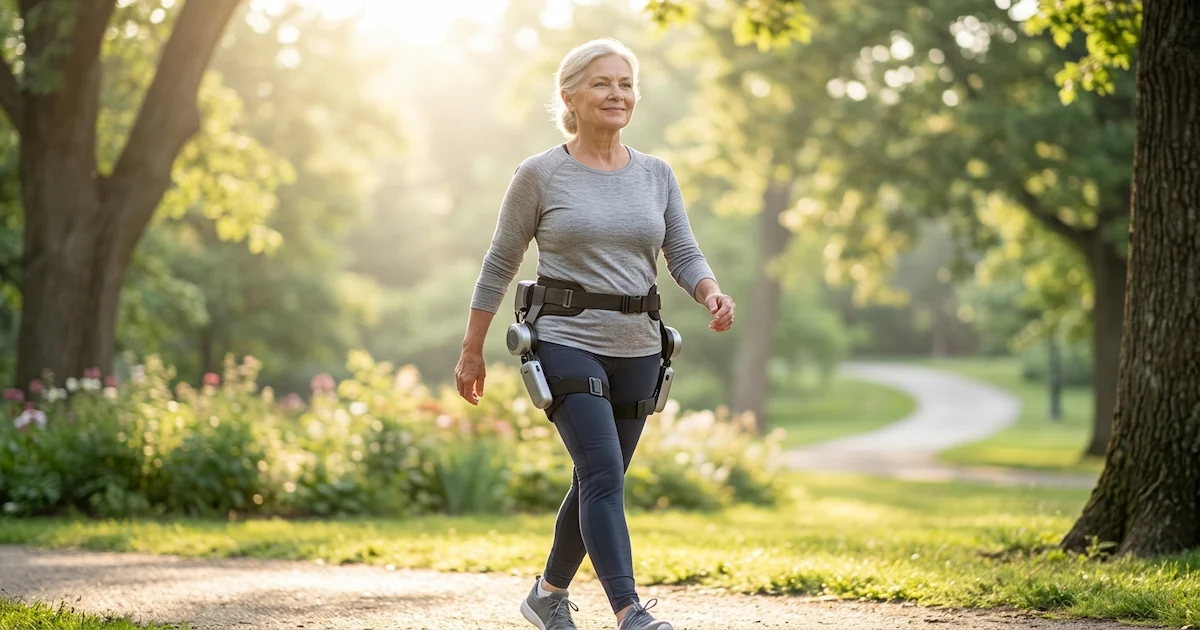
The AlpWalk S1, showcased at IFA Berlin 2026 and recognized as an IFA Innovation Award Honoree, represents a new generation of mobility technology designed specifically for seniors. Unlike a cane or walker, the S1 is a wearable device that provides motorized assistance at the hip joint, reducing the energy required to walk by up to 35%.
Key features of the AlpWalk S1 include:
- Hip-joint motors that provide assistive torque during everyday walking, uphill climbs, and stair use
- Gentle-Pace AI gait algorithm trained on over 10,000 elderly gait samples, with 99% accuracy in recognizing walking, uphill, stair-climbing, and standing states
- Ultra-lightweight, foldable frame that packs into a 20-liter backpack
- 0.1-degree precision joint-angle control with multi-layer mechanical safety stops
- Up to 6 hours of battery life (20 km range) with fast charging and swappable batteries
For someone with hip arthritis or chronic hip pain, the S1 could mean the difference between a short, painful walk and a longer, more comfortable one. It's not a replacement for medical treatment—but it's a powerful tool for maintaining the active lifestyle that weight maintenance demands.
Research on similar hip exoskeletons has shown measurable benefits. A 2025 study in Scientific Reports found that a lightweight hip exoskeleton (1.6 kg) improved walking speed by 14.8% and reduced metabolic energy consumption by more than 10% in elderly participants after just four weeks of use.
Building Your Post-Ozempic Maintenance Plan
So what does a realistic maintenance plan look like? Here's a framework based on the research:
1. Start Exercise During Treatment, Not After
The Danish study's most important insight: The people who maintained weight loss were already exercising while on the medication. Don't wait until you stop to build the habit. Start now.
Goal: 150–300 minutes of moderate-intensity activity per week (about 2–4 hours)
2. Prioritize Enjoyable Movement
Exercise that feels like punishment won't last. The BMJ research emphasizes that enjoyable, moderate-intensity activity produces the greatest emotional reward and is most sustainable. Walking with a friend, swimming, dancing, gardening—whatever gets you moving and doesn't feel like a chore.
3. Address Pain Proactively
If hip pain, knee pain, or arthritis is limiting your activity, don't ignore it. Talk to your doctor about:
- Physical therapy to strengthen supporting muscles
- Mobility aids (canes, stair assists, exoskeletons) that make movement more comfortable
- Pain management strategies that don't interfere with your goals
4. Use Mobility Aids Without Shame
There's no virtue in struggling. A stair-climbing cane for your home, a hip-assistive exoskeleton for longer walks, or a simple cane for hip pain during flare-ups—these are tools, not signs of failure. They're what allow you to keep moving when your body needs extra support.
5. Plan for the Taper
If you and your doctor decide to stop the medication, consider a gradual dose reduction rather than an abrupt stop. This gives your body time to adjust and gives you space to solidify new habits.
6. Stay Connected to Support
The Cleveland Clinic study found that many patients who maintained weight loss did so with ongoing professional support—dietitians, exercise specialists, or structured programs. You don't have to do this alone.
The Bottom Line
The fear of rebound weight after Ozempic is real—and it's valid. The science shows that most people do regain some weight after stopping GLP-1 medications. But the same science also shows that maintenance is absolutely possible, especially when exercise is part of the equation.
The formula isn't complicated: Move your body regularly. Address the barriers that make movement hard. Use the tools available to you.
If sore hips are holding you back, explore your options. A stair-climbing cane can make your home safer and more navigable. A hip-assistive exoskeleton like the AlpWalk S1 can make longer walks feel effortless again. These aren't luxuries—they're investments in the active lifestyle that protects your results.
The medication gave you a head start. Your movement is what keeps you going.
Related Articles
- Food as Medicine: 5 Conditions You Can Improve Through Diet
- 5 Simple Recipes for Optimal Gut Health
- 30+ High-Fiber Breakfast Ideas That Actually Taste Good
- How to Build a Productive Morning Routine
This article is for informational purposes only and does not constitute medical advice. Always consult with a qualified healthcare provider before making significant changes to your diet, exercise routine, or medication, especially if you have a pre-existing medical condition.