
Endocrine Disruptors in Plastics: What Men Need to Know
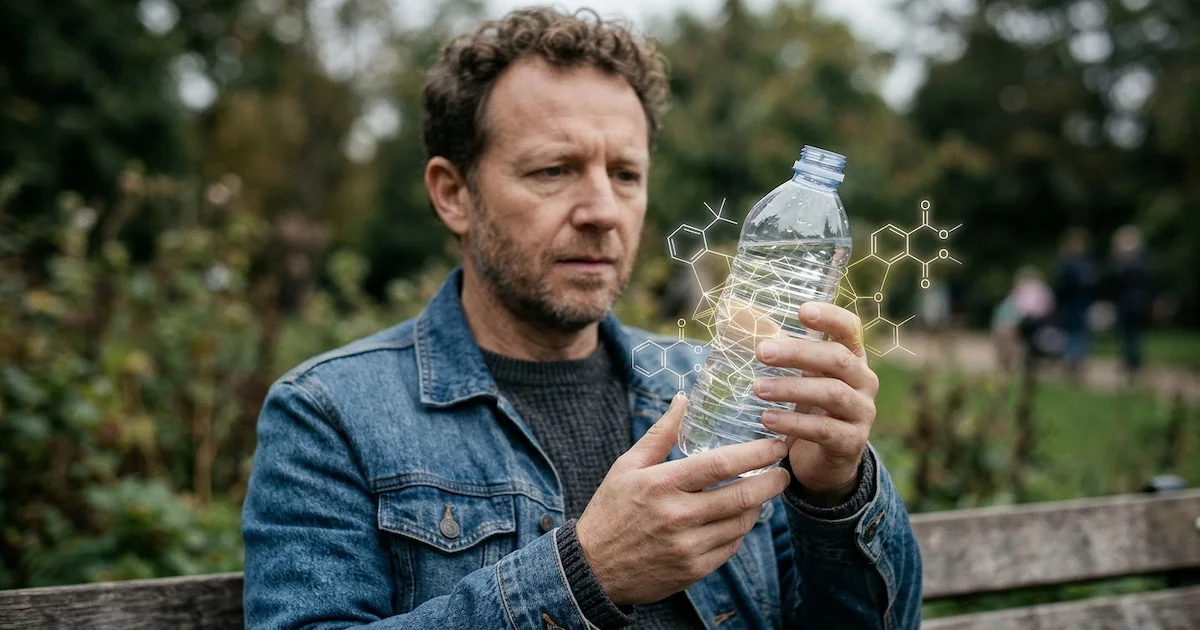
If you are a man who drinks from plastic bottles, eats takeout from plastic containers, or stores leftovers in last night's plastic takeout box, you are being exposed to chemicals that can interfere with your hormones. This is not a fringe concern. A growing body of research links common plastic additives—particularly bisphenols and phthalates—to lower testosterone, poorer sperm quality, and disrupted reproductive development.
The uncomfortable truth is that "BPA-free" does not mean safe. And the tiny particles shedding off your plastic gear may be making the chemical exposure worse, not better.
Here is what the science actually says, and what you can do about it without turning your life upside down.
What Are Endocrine Disruptors, and Why Should Men Care?
Your endocrine system runs on hormones—chemical messengers that tell your body what to do. Testosterone is the headline hormone for men, but estrogen, thyroid hormones, and insulin all matter too. Endocrine-disrupting chemicals (EDCs) are substances that mimic, block, or otherwise scramble those signals.
Plastics are a major source. Two families of chemicals deserve most of your attention:
Bisphenols (BPA, BPS, BPF). Used to make polycarbonate plastics and epoxy linings inside food cans. BPA was originally synthesized as a synthetic estrogen, and its structure is close enough to estradiol that it can bind estrogen receptors. It has been shown to accelerate puberty in both boys and girls, and animal studies suggest it can impair testosterone production and sperm function.
Phthalates. Used to soften plastics and as carriers in fragrances and personal care products. They are anti-androgenic, meaning they can suppress androgen (male hormone) activity. Adolescent males with higher urinary phthalate levels tend to have lower free testosterone and other bioactive sex hormones.
Microplastics. The particles themselves are not inert. They act as "Trojan horses"—adsorbing bisphenols and other EDCs onto their surfaces and then releasing them in concentrated doses once inside the body. Studies in animal models show microplastics can disrupt testosterone synthesis through oxidative stress and inflammation in testicular tissue.
What the Research Says About Men's Health
Testosterone and Hormonal Balance
A 2025 study using U.S. national health data found that exposure to a mixture of 17 EDCs—including phthalates, parabens, and phenols—was consistently associated with reduced total testosterone, free testosterone, and other bioactive sex hormones in males aged 12 to 19. This is a critical developmental window. The researchers noted that combined exposure to multiple chemicals can produce effects greater than any single substance alone.
Animal studies reinforce the concern. Microplastic exposure has been shown to reduce testosterone synthesis in rats through a cascade beginning with oxidative stress and progressing to impaired steroidogenesis. In vitro work on human sperm shows that bisphenols at environmentally relevant concentrations can impair motility, capacitation, and the acrosome reaction—the sperm's toolkit for fertilizing an egg.
Sperm Quality and Fertility
Bisphenol exposure has been linked to azoospermia (absent sperm in ejaculate) and oligozoospermia (low sperm count) in clinical studies. One case-control study found significantly higher urinary BPA levels in men with azoospermia compared to fertile controls. A multi-omics study identified 26 EDCs—including BPA—that interact with genes causally linked to non-obstructive azoospermia, suggesting a direct EDC-gene-infertility axis.
The effects may even cross generations. A 2026 study found that paternal exposure to BPA and its substitute BPS at environmentally relevant doses induced testicular dysfunction in male offspring, with effects persisting into puberty. The mechanism involved disruption of carnitine transport, impaired mitochondrial energy metabolism, and increased oxidative stress in the testes.
The BPA-Free Trap
Here is where it gets frustrating. When manufacturers removed BPA from products, they largely replaced it with BPS or BPF—chemical cousins with similar endocrine-disrupting profiles. A product labeled "BPA-free" can still leach bisphenols that behave like BPA in the body. The European Union has recognized this problem and moved to ban bisphenols as a class in food contact materials, rather than one chemical at a time. U.S. federal regulators have been slower to act.
Practical Steps to Reduce Your Exposure
You cannot eliminate plastic from modern life. But you can reduce the dose, and dose matters. Here is what the evidence supports, ordered from highest impact to easiest wins.
1. Stop heating food in plastic
Heat dramatically increases the migration of additives from plastic into food. Reheat in glass, ceramic, or stainless steel. Even "microwave-safe" plastic is not your friend here.
- Top Pick: Replace plastic containers with a tempered glass set like the Pyrex Simply Store 10-Piece Glass Food Storage Set (~$50).
- Cooking Swap: Ditch black plastic spatulas and spoons for heat-resistant wood like the OXO Good Grips Wooden Spoon Set (~$17).
2. Swap your daily water bottle
If you use a plastic bottle daily, replace it with stainless steel or glass. This is a one-time purchase with a measurable reduction in bisphenol exposure. Avoid leaving plastic bottles in hot cars.
- Stainless Steel: Klean Kanteen Classic 27oz Stainless Water Bottle (~$26) — 18/8 food-grade steel with zero plastic lining.
- Glass: MUKOKO 32-Oz Glass Water Bottle (~$23) — Heavy-duty glass with a protective silicone grip.
3. Filter your drinking water for microplastics
Tap water and single-use bottled water are both common sources of microplastics and chemical runoff. Using a dedicated glass or counter-top filter pitcher removes these contaminants at the source.
- Top Pick: The LifeStraw Home 7-Cup Glass Water Filter Pitcher (~$65) is independently tested to remove microplastics, PFAS, and heavy metals.
4. Check your personal care products
Phthalates hide under the word "fragrance" on ingredient lists. Choosing "fragrance-free" products (not "unscented," which can still contain masking fragrances) reduces one major route of daily dermal exposure.
- Body Wash: Every Man Jack Fragrance-Free Sensitive Body Wash (~$30) — Free of phthalates, parabens, and synthetic dyes.
- Deodorant: Native Unscented Natural Deodorant (~$14) — Clean, phthalate-free protection.
5. Be skeptical of "BPA-free"
Look for glass or stainless steel for food storage rather than hunting for the "right" plastic. If you must use plastic, avoid recycling codes 3, 6, and 7, which are most likely to contain problematic additives.
6. Do not stress about perfection
The goal is reducing cumulative load, not achieving zero exposure. A 2026 review concluded that while direct human evidence on microplastic-bisphenol interactions is still limited, the biological plausibility is strong enough to justify precautionary behavior.
The Bottom Line for Men
The evidence is not yet at the level of "this plastic bottle will make you infertile." Human causal data is hard to come by, and the research community is candid about those limitations. But the direction of the evidence is consistent: plastic-derived endocrine disruptors are associated with lower testosterone, poorer sperm quality, and disrupted hormonal development, and the mechanisms are biologically plausible.
For men thinking about fertility, or simply thinking about aging well with healthy hormones, reducing unnecessary plastic contact—especially with food and heat—is a low-cost, low-risk intervention with a plausible upside.
Your hormones are worth a glass container.
📚 Sources & Further Reading
-
ScienceDirect. "Unraveling the endocrine disruption potential of microplastics in testosterone regulation." 2025.
-
Hong Y, et al. "Endocrine disruptors and male infertility: multi-omics identification of key genes in non-obstructive azoospermia." J Assist Reprod Genet. 2025;42(11):3767-3780. PMID: 40956397.
-
ScienceDirect. "Microplastics as trojan horses: A new perspective on bisphenol toxicity in male infertility and assisted reproduction." 2026.
-
ScienceDirect. "Effects of exposure to 17 endocrine disrupting chemicals on sex steroid hormone levels in 12- to 19-year-old males in the United States." 2025.
-
ScienceDirect. "Paternal BPA and BPS exposure induce testicular dysfunction in pubertal male offspring." 2026.
-
NYU Langone Health. "Seven Tips for Reducing Your Exposure to Microplastics & Plastic Additives." March 2026.
-
Petrie-Flom Center, Harvard Law School. "BPA-free Does Not Mean Bisphenol-free and How Regulators are Grappling to Deal with It." November 2024.
-
Beni-Suef University Journal of Basic and Applied Sciences. "High levels of bisphenol A among infertile men can impair spermatogenesis by oxidative stress and elevated levels of microRNA-337." 2024.