
Beyond Stretching: 5 Somatic Movements to Release Chronically Tight Hips
You've stretched. You've held pigeon pose for two minutes on each side. You've used the foam roller until you winced. And yet, your hips still feel like they're wrapped in a tight band that never quite loosens.
You're not alone—and more importantly, it's not your fault. The problem may not be that your hips are "too short" or that you're not stretching hard enough. The problem may be that you're talking to the wrong part of your nervous system.
Why Stretching Often Fails for Tight Hips
Conventional static stretching works on a mechanical model: pull the muscle, hold it, and it will lengthen. But your muscles don't operate in isolation—they take orders from your brain. When you hold a stretch, you're pulling on tissue that your nervous system has deliberately told to stay contracted. That's a protective mechanism.
When a muscle is held in a state of chronic contraction, the brain has essentially forgotten how to let it go. This phenomenon is called Sensory Motor Amnesia—your brain has lost the ability to voluntarily relax certain muscles. Static stretching doesn't address this because it bypasses the brain entirely. You're pulling on a muscle that your nervous system is actively telling to stay tight. As one clinical somatic educator puts it, "What muscles need is a deep release of the tension they're being told to hang onto by the brain, all day and night long."
This is especially true for the hip flexors, including the psoas—a deep core muscle that connects your lumbar spine to your femur. Because it's buried deep within the body, it's difficult to sense and nearly impossible to stretch effectively with conventional methods. A tight psoas can contribute to lower back pain, hip tension, snapping hip syndrome, and even sciatica.
What Is Pandiculation? The Brain's Natural Reset Button
Think about what you do when you wake up in the morning. You arch your back, reach your arms overhead, and let out a big yawn. That involuntary, satisfying stretch is pandiculation—and it's the key to releasing chronic muscle tension.
Pandiculation is a three-step process:
- Voluntary contraction: You gently contract the tight muscle, bringing it into a state of slight tension.
- Slow release: You slowly, consciously release the contraction—much slower than you contracted it.
- Complete relaxation: You let the muscle go completely limp, allowing the nervous system to register a new, lower baseline of tension.
The critical difference from static stretching is that pandiculation engages the brain. By voluntarily contracting the muscle first, you send a clear signal to your nervous system about what the muscle is doing. When you then slowly release, the brain receives updated sensory feedback and can consciously let go of the holding pattern.
Static stretching, by contrast, is passive. It pulls on the muscle without involving the brain's motor control centers. As a result, any length gained is temporary, and the muscle often returns to its guarded state—sometimes even tighter than before. Pandiculation, on the other hand, creates lasting change because it retrains the nervous system's sense of what "normal" tension feels like.
The 10-Minute Somatic Hip Release Routine
This routine is designed to be done on a mat or in bed, first thing in the morning or before sleep. Move slowly. Use about 30-50% of your maximum effort. The goal is not to stretch or push—it's to sense and release.
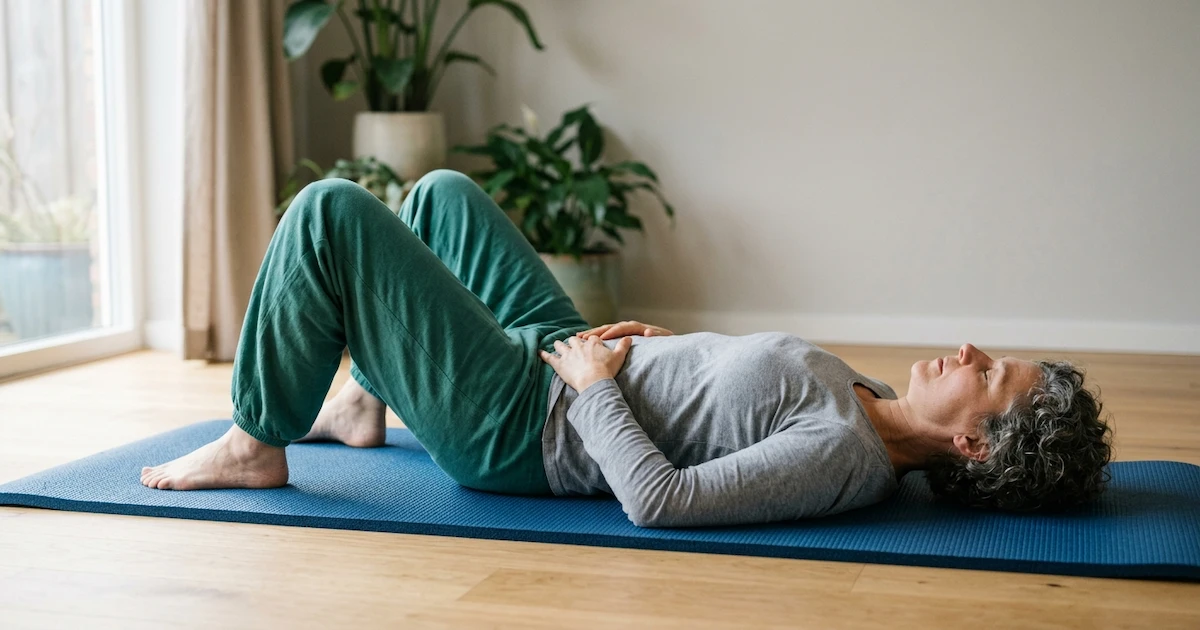
Before you begin: Lie on your back with your knees bent and feet flat on the floor, hip-width apart. Take a few slow breaths. Notice where your body meets the floor. Don't change anything yet—just observe.
Movement 1: Pelvic Tilt (2 minutes)
This gentle rocking motion wakes up the connection between your brain and your deep hip muscles.
- Slowly tip your pelvis so your lower back presses gently into the floor. Contract your lower abdominal muscles slightly as you do this—just enough to feel the movement.
- Hold for a breath, then slowly release, letting a small arch return to your lower back.
- Keep the movement small and smooth. After 8-10 slow rounds, pause and rest. Notice if your lower back feels different against the floor.
Movement 2: Knee Wandered In (2 minutes)
This is a pandiculation for the hip rotators and adductors.
- Let one knee drift slowly toward the midline of your body, turning the hip gently inward. Contract the inner thigh slightly as the knee moves in.
- Hold for a breath, then slowly release, letting the knee return to its starting position.
- Do 6-8 slow repetitions, then switch sides. Rest and notice any difference between the two hips.
Movement 3: Knee Wandered Out (2 minutes)
Now the opposite direction—targeting the outer hip and glutes.
- Let the same knee fall slowly outward, part way only—not a full stretch, just a gentle opening. Contract the outer hip slightly as it moves.
- Hold for a breath, then slowly release, bringing the knee back to center.
- Do 6-8 slow repetitions on each side. If anything pinches, make the movement smaller.
Movement 4: Heel Slide with Hip Rotation (2 minutes)
This integrates hip flexion with rotation—a movement pattern your hips use every day.
- With both knees bent, slowly slide one heel away from you while keeping your foot on the floor. As the leg extends, let the hip rotate slightly outward. Contract the front of your hip gently as you slide.
- Hold for a breath, then slowly release, sliding the heel back to the starting position.
- Do 5-6 slow repetitions per side. Keep the movement smooth and unforced.
Movement 5: Full-Body Pandiculation (2 minutes)
This is the integration movement—a voluntary, full-body yawn.
- Reach both arms overhead and simultaneously lengthen both legs away from you. Contract your whole body gently—arms, legs, core, even your face. Yawn if you feel one coming.
- Hold the contraction for 3-5 seconds, then release everything at once, letting your arms and legs drop heavily into the floor.
- Rest completely for 10-15 seconds. Repeat 3-4 times. Notice the feeling of heaviness and release in your hips.
What to Expect (and What Not To)
After this routine, most people notice a subtle but distinct shift: the hips feel heavier, softer, or more even. One side may feel different from the other—that's normal and informative. Over days and weeks of practice, these small movements retrain the nervous system's baseline for how much tension the hips need to hold.
This is not a quick fix. Chronic tension patterns took years to develop, and they release gradually. Practice this routine daily for two weeks before judging its effects. Some people notice immediate relief; others notice cumulative change over time.
What this routine is not: it's not a substitute for medical care. If you have acute hip pain, a diagnosed injury, or a condition like osteoarthritis, consult a healthcare provider before beginning any movement practice.
The Takeaway
Your hips are not tight because they need to be pulled harder. They're tight because your brain is holding them in a protective pattern that it has forgotten how to release. Pandiculation speaks the language your nervous system understands—voluntary contraction followed by slow, conscious release. It's the difference between forcing a door open and asking it to unlock.
Ten minutes. Five gentle movements. A conversation with your nervous system instead of a tug-of-war with your tissues. That's the somatic approach to hip release.
This article is for educational purposes only and is not a substitute for professional medical advice. Always consult with a qualified healthcare provider before starting any new movement or treatment program.