
The 7-Day Drug-Free Protocol to Reboot Your Sleep Cycle
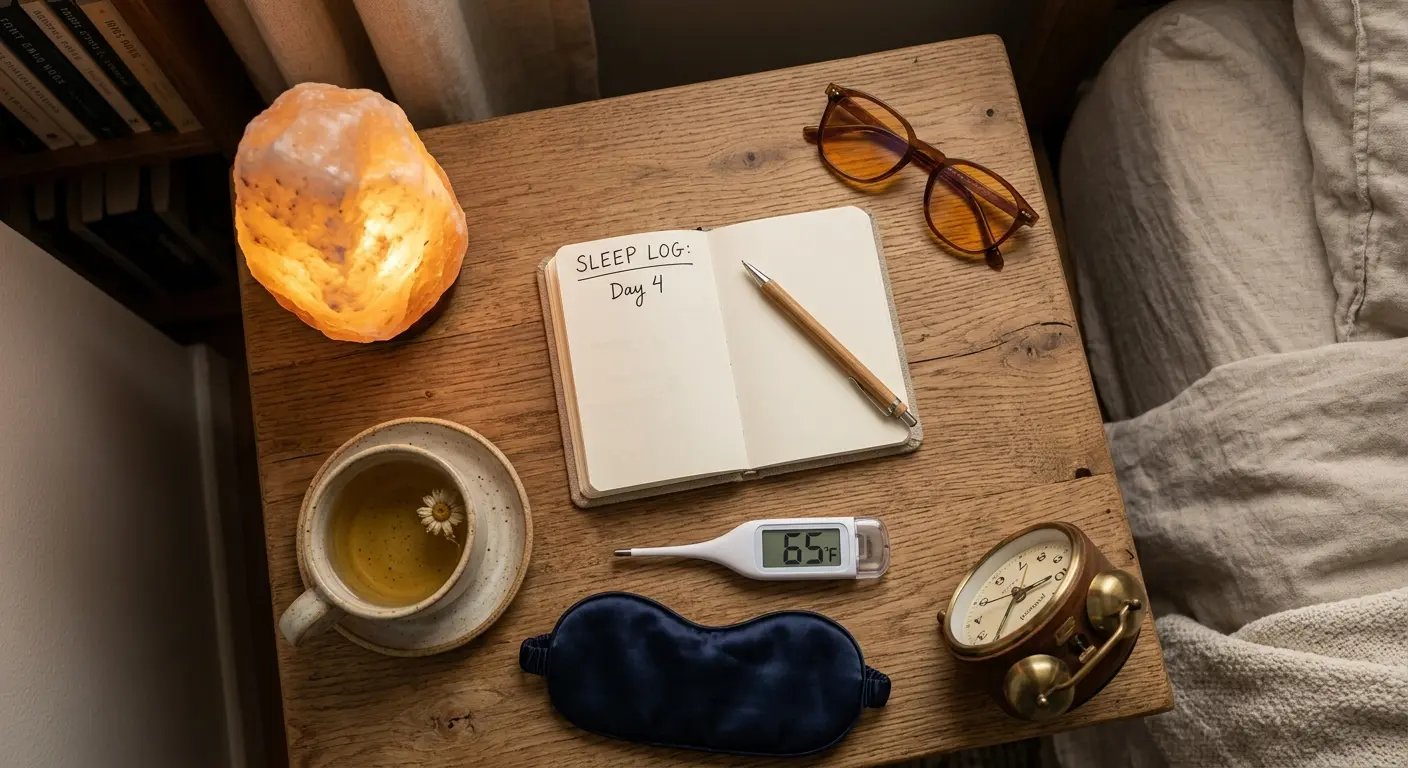
You're not looking for platitudes. You're looking for a build.
This is a lab‑style, drug‑free protocol for re‑aligning your internal clock without pharmaceuticals. Across seven evenings, you'll execute a reproducible sequence that leverages controllable environmental inputs: timed light exposure, targeted cooling and warming, breath cadence, meal timing, and low‑noise cognitive off‑ramps.
Zero supplements. All environment.
Here's your precise, hour‑by‑hour blueprint.
The Science: Why This Works
Your sleep‑wake cycle is governed by the suprachiasmatic nucleus (SCN) — your brain's master clock. This clock is set by external cues called zeitgebers (German for "time givers"). The most powerful zeitgebers are:
- Light — Morning bright light advances your clock; evening blue light delays it
- Temperature — A natural drop in core body temperature signals sleep onset
- Meal timing — When you eat tells your peripheral clocks when to expect activity or rest
- Breath — Controlled respiration down‑regulates the nervous system
- Cognitive load — Unprocessed thoughts keep your brain in high‑alert mode
This protocol systematically optimizes all five.
Before You Begin: The Rules
- Anchor your wake time — Pick a wake time and do not deviate for all 7 days
- No naps — Sleep pressure is your ally in this reset
- Track your progress — Log your sleep onset latency and wake‑after‑onset each morning
- If you slip — Don't restart. Just pick up the next day and continue
The Daily Protocol Matrix
| Time Window | Action | Duration | Mechanism |
|---|---|---|---|
| Within 30 min of waking | Bright light exposure (sunlight or 10,000 lux lamp) | 20–30 min | Phase advances circadian clock |
| Morning (first 4 hours) | Keep lights bright (500+ lux) | All morning | Reinforces wake signal |
| Midday (hours 4–10) | Moderate light (200–500 lux) | All afternoon | Maintains circadian alignment |
| 2–3 hours before bed | Final meal of the day | — | Prevents digestion from interfering with sleep |
| 2 hours before bed | Dim all lights to <30 lux; activate blue‑light filters on all devices | Until bedtime | Allows melatonin rise |
| 90 minutes before bed | Begin wind‑down: dim to candlelight (5–10 lux) | 90 min | Triggers parasympathetic nervous system |
| 60 minutes before bed | Cognitive off‑loading (write down tomorrow's tasks) | 5–10 min | Prevents task rumination |
| 30 minutes before bed | Breathwork protocol (4‑7‑8 or cyclic breathing) | 5–10 min | Down‑regulates nervous system |
| At bedtime | Cool room to 65°F (18°C); warm hands and feet | All night | Facilitates core body temperature drop |
Day 1 — Set the Anchor
Morning (within 30 minutes of waking):
- Get outside into natural sunlight for 20–30 minutes. If it's overcast or you're up before sunrise, use a 10,000 lux light box positioned at eye level.
- Keep indoor lights bright for the first 4 hours of your day.
Afternoon:
- Maintain moderate light levels. If you're indoors, sit near a window.
Evening (2 hours before bed):
- Turn off overhead lights. Switch to lamps with warm (2700K or lower) bulbs.
- Activate night mode on all screens. Better yet, put devices away entirely.
Evening (1 hour before bed):
- Cognitive off‑loading: Take a piece of paper and write down every task, worry, or thought that's on your mind. Then fold it up and put it aside. This tells your brain: "I've recorded this. I don't need to hold it."
Evening (30 minutes before bed):
- Breathwork: Practice the 4‑7‑8 method — inhale for 4 seconds, hold for 7, exhale for 8. Repeat 4–6 cycles.
- Set your thermostat to 65°F (18°C). If you have a smart mattress or cooling pad, activate the pre‑cooling cycle.
Bedtime:
- Get into bed at your scheduled time. If you can't fall asleep within 20 minutes, get up, sit in dim light, and read a paper book until sleepy. Do not stay in bed awake.
Day 2 — Reinforce the Wake Signal
Morning:
- Repeat the morning light exposure within 30 minutes of waking.
- Consider adding a brief walk outdoors to combine light with movement.
Throughout the day:
- Keep your wake time consistent. No sleeping in.
- Expose yourself to as much natural light as possible.
Evening:
- Repeat the evening sequence from Day 1.
- Add a warm foot bath or shower 90 minutes before bed. Warming your extremities (hands and feet) helps your core temperature drop more efficiently, which is the primary signal for sleep onset.
Day 3 — Tighten the Meal Window
Morning & Afternoon:
- Continue the light and temperature protocols.
- Pay attention to meal timing: Have your last meal of the day at least 2–3 hours before bedtime. This allows your digestive system to quiet down before sleep.
Evening:
- If you feel hungry before bed, a small snack is acceptable — but keep it under 150 calories and avoid sugar and protein. A few crackers or a small banana works.
Day 4 — Optimize the Wind‑Down
Morning & Afternoon:
- Continue all previous protocols.
Evening:
- Extend your wind‑down to a full 90 minutes. This is non‑negotiable.
- Dim lights progressively: at 90 minutes out, switch to 30 lux (think: a single warm lamp). At 60 minutes, drop to 10 lux (candlelight equivalent).
- No screens after the 90‑minute mark. If you must use a device, use red‑shift mode and keep brightness at minimum.
Day 5 — Layer in Proprioceptive Cues
Morning:
- Continue morning light exposure.
Evening:
- Add proprioceptive loading — this is a fancy term for gentle physical input that grounds your nervous system. Try:
- A 10‑minute gentle yoga or stretching session 90 minutes before bed
- Progressive muscle relaxation: tense and release each muscle group from toes to scalp
- A weighted blanket (if you have one)
Bedtime:
- Combine your breathwork with progressive muscle relaxation for maximum down‑regulation.
Day 6 — Fine‑Tune Temperature
Morning:
- Continue all previous protocols.
Evening:
-
Dial in your temperature protocol:
- 90 minutes before bed: warm hands and feet (foot bath, warm socks, or a hot water bottle at your feet)
- At bedtime: room at 65°F (18°C)
- If you have a smart mattress or cooling device, set it to start cooling 30 minutes before bedtime
-
The goal is to accelerate the natural 1–2°F drop in core body temperature that triggers sleep.
Day 7 — Consolidate and Lock In
Morning:
- By now, your wake time should feel natural. Continue the morning light exposure — this is now a permanent habit.
Evening:
- Run the full protocol one more time with precision:
- 2 hours before bed: dim lights, blue‑light filters
- 90 minutes: start wind‑down
- 60 minutes: cognitive off‑loading
- 30 minutes: breathwork + temperature prep
- Bedtime: cool room, warm extremities
Celebrate: You've just completed a full circadian reset. Your sleep onset latency should be significantly reduced, and your sleep quality should feel deeper and more restorative.
What to Do If You Slip
Life happens. If you miss a morning light session or stay up late one night:
- Do not panic — one slip doesn't undo the protocol
- Maintain your anchor wake time — this is the most important variable
- Pick up where you left off the next day
- If you miss more than two days, restart from Day 1
The Takeaway
This isn't a collection of vague sleep hygiene tips. It's a precise, reproducible sequence of environmental interventions that systematically recalibrate your circadian rhythm.
No supplements. No pills. Just light, temperature, food timing, breath, and a clean cognitive off‑ramp.
Your sleep cycle isn't broken — it's just misaligned. And misalignment can be fixed.
Start tonight. Reboot in 7 days.
This article is for educational purposes only and is not a substitute for professional medical advice. Always consult with a qualified healthcare provider or physical therapist before choosing a walking aid, especially if you have hip arthritis or another chronic condition.